 Lakeland Mobile Home Leveling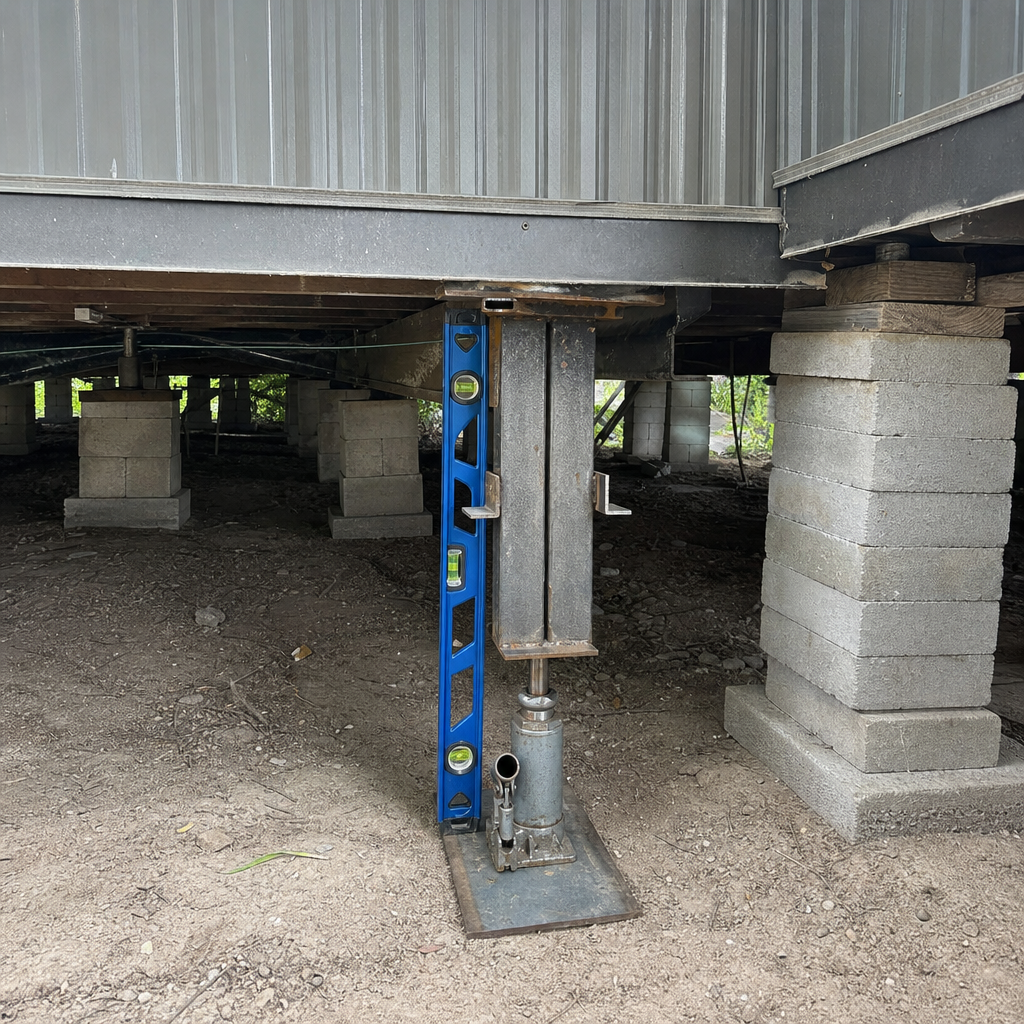
Lakeland Mobile Home Leveling relevels settled mobile and manufactured homes across Lakeland and Polk County. We map your frame with a water level, lift the low points with hydraulic jacks, and rebuild the piers and shims until the whole chassis sits flat again. A singlewide relevel runs $450–$800, a doublewide $750–$1,400, and the level check that tells you exactly where your home stands is free.
If you’re here because a door stopped latching or the floor has developed a slope you can feel in your socks, you’re in the right place, and you have a lot of company. About one in five homes in Lakeland is a manufactured home, one of the highest shares of any city its size in the country. From the big 55+ communities off US-98 North like Cypress Lakes Village, to the parks strung along US-92 toward Auburndale, to Combee Settlement and the older stock around Highland City, this county runs on manufactured housing. And nearly all of it sits on the same thing: block piers on sandy Central Florida ground that never stops moving.
Why homes here go out of level
The soil is sand, and sand compacts. Most of Polk County is sandy soil that consolidates and washes under the concentrated loads a pier puts into the ground. Each pier carries thousands of pounds on a footprint the size of a doormat. Add the June-through-September rainy season, afternoon storms dumping inches at a time, and the ground under the wet side of a home gives up faster than the dry side. That differential settling is what tweaks the frame, and the frame is what your doors, windows, and floors all hang off of.
Storms accelerate everything. When Hurricane Milton crossed Polk County in October 2024, the Lakeland area took over 12 inches of rain in 24 hours, a once-in-a-thousand-year rainfall event. Ground that saturated lets piers sink and anchor straps go slack. Milton’s damage still shows up under homes today: piers that dropped an inch on one side, straps you can flex by hand, torn vapor barriers where the underbelly took on water. If your home rode out Milton and hasn’t had the frame shot since, a free level check is cheap insurance.
The housing stock is old enough to matter. A large share of Polk County’s park inventory dates to the 1970s and 80s, pre-1976 homes built before the HUD code existed, and pre-1994 homes built before the wind standards were toughened after Hurricane Andrew. Older homes tend to have fewer anchors, longer runs between piers, and decades of accumulated shimming. They need more careful work, and they’re exactly the homes where tie-downs and anchors deserve a hard look at the same time as the relevel.
The work, and what each piece costs
- Mobile home leveling: the core service. Water-level survey of every pier, hydraulic jacking on solid cribbing, new hardwood shims driven tight, full re-shoot to verify. Singlewide $450–$800, doublewide $750–$1,400.
- Pier & pad repair: reset and reshim ($75–$150 per pier) or fully rebuild crushed and sunken piers with new blocks, caps, and pads ($150–$400 per pier).
- Tie-downs & anchors: install, replace, and re-tension ground anchors and straps to Florida Rule 15C-1 and your wind zone. Full installs and retrofits run $600–$3,500.
- Vapor barrier replacement: repair or replace the underbelly moisture barrier that keeps Florida ground moisture out of your floors and insulation. Patches $300–$800, full replacement $1,200–$4,500.
- Subfloor & floor repair: soft, saggy, or bouncy spots opened up, the rotted decking cut out and replaced, and the water source and pier support under it fixed so the floor stays firm. A section typically runs $500–$700; a whole floor $1,800–$3,000.
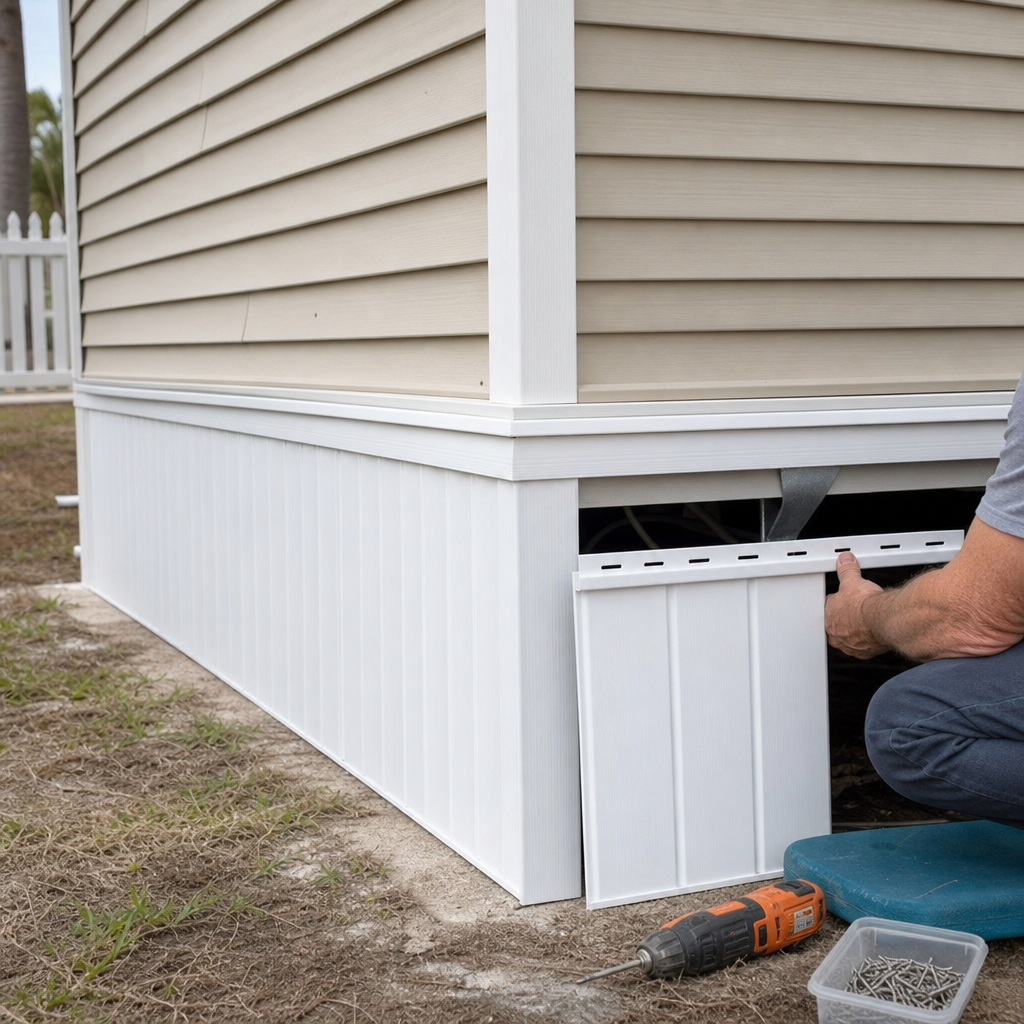
- Skirting repair: fix the buckled panels, vents, and access doors that settling tears up. Repairs $200–$800, full replacement $900–$2,500.
- Carports & screen rooms: rescreening, loose or rusted fasteners, leaks at the joint where the roof meets the home, and rooms that racked when the home settled. A rescreen typically runs $250–$1,000; bigger repairs are quoted after a look.
- Pre-sale leveling inspection: a documented level, support, and tie-down check with a written report for park managers, lenders, and buyers. $150–$350, usually credited toward any work found.
Not sure which of these you need? The mobile home repair guide goes symptom by symptom. We work across Lakeland and Winter Haven, Auburndale, Plant City, Bartow, Mulberry, Lake Wales, and Polk City.
How a relevel works: the honest version
There’s no mystery to this job, and we will walk you through every step. First we pull skirting access panels, get under the home, and shoot every pier with a water level off the most stable pier. That produces a map of the frame: exactly which piers dropped and by how much, down to fractions of an inch. While under there we check every pad and cap for crushing, every shim stack for rot, and every anchor strap for slack.
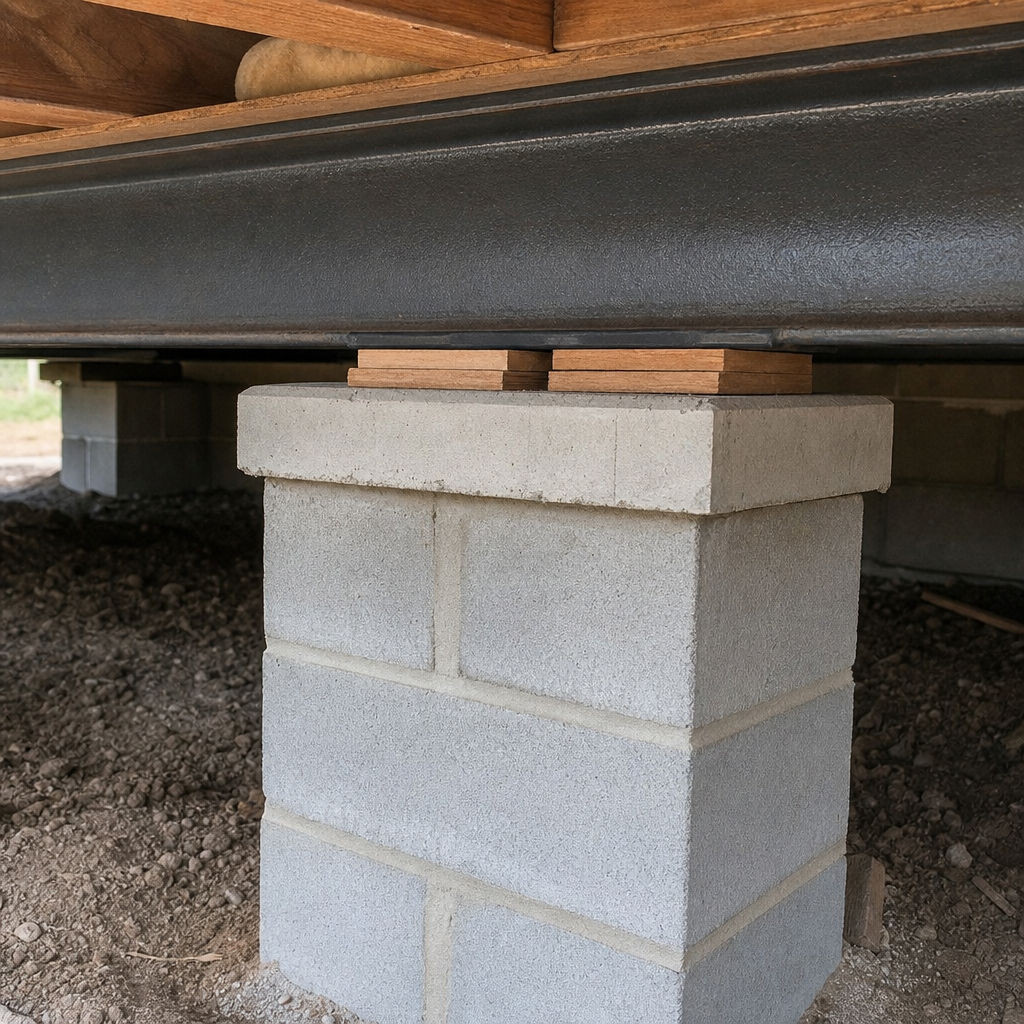
Then the lift. 20-ton hydraulic bottle jacks set on solid wood cribbing, never a jack alone, placed at the frame near each low pier. The home is raised in small increments, working back and forth across the frame, because cranking one point far out of plane is exactly what cracks drywall and pops trim. As each section comes up to the line, the pier under it is rebuilt: re-stack or replace blocks, swap crushed caps, and drive hardwood shims tight between pier cap and I-beam. HUD installation standards limit how tall a shim stack can be, a pier that needs a tall stack gets rebuilt properly, not stuffed with lumber.
Finally we re-shoot the entire frame to verify every reading, confirm every pier is actually carrying load (a pier you can rattle by hand is doing nothing), close the marriage line on doublewides, re-tension the anchor straps a settled home always leaves slack, and put your skirting back. Most homes: done in a day.
Straight pricing, published
Hardly anyone in Polk County prints numbers. Here are the typical ranges:
| Service | Typical range |
|---|---|
| Relevel, singlewide | $450–$800 |
| Relevel, doublewide | $750–$1,400 |
| Pier reset/reshim | $75–$150 per pier |
| Pier rebuild | $150–$400 per pier |
| Tie-downs & anchors | $600–$3,500 |
| Vapor barrier | $300–$4,500 |
| Subfloor section | $500–$700 |
| Skirting | $200–$2,500 |
| Pre-sale inspection | $150–$350 |
Expect a flat quote after the free level check; the pricing page breaks down exactly what moves a job toward the low or high end of each range. As structural work goes, releveling sits at the affordable end: a few hundred dollars now, against the subfloor, drywall, and slack-strap problems a frame breeds when it rides out of level for years.
The sinkhole question, answered honestly
Polk County sits on karst limestone in Florida’s sinkhole-prone belt, and every homeowner here has seen the news stories. So let’s be straight: the overwhelming majority of settling under mobile homes is ordinary soil compaction under the piers, not sinkhole activity. Piers concentrate load on sandy ground; the ground compacts; the home settles. That’s a maintenance problem with a known fix.
That said, the distinction is real. If the survey turns up a pattern that doesn’t look like normal pier settling (a depression forming in the ground itself, piers dropping fast in a concentrated circular area, ground cracks), that’s a question for a geotechnical professional, not a leveling crew, and we will tell you so. A relevel does not fix a sinkhole, and anyone who shims over one is doing you real harm. Honest diagnosis first, always.
Licensing: why it matters in Florida
Florida doesn’t treat this work as odd jobs. Under §320.8249, Florida Statutes, leveling, blocking, and tie-down work on an installed mobile home must be performed by a state-licensed mobile home installer, working to the installation standards in Rule 15C-1 of the Florida Administrative Code, and anchor work in Polk County often requires a county permit and inspection. Ask for the licence number before anyone crawls under. Never let an unlicensed handyman jack up your home: you inherit the liability, the insurance exposure, and usually a worse relevel.
One more honest thing
On Polk County sand, releveling is periodic maintenance, not a permanent fix. Unless the drainage or pad problems under a home are corrected, expect to need a touch-up relevel every 3–5 years. Better to hear that up front, and to have us point out the gutter downspout dumping water at your piers while we’re under there, than to pretend one visit lasts forever. Parks off US-98 and US-92 and homes on their own land out toward Kathleen are all inside our map, and we write the flat quote from your pier readings. Read more about how we work, check the FAQ, or request your free level check now. We cover Lakeland plus Winter Haven, Auburndale, Plant City, and Bartow.