 Lakeland Mobile Home Leveling
 Mobile Home Leveling in Lakeland, Florida
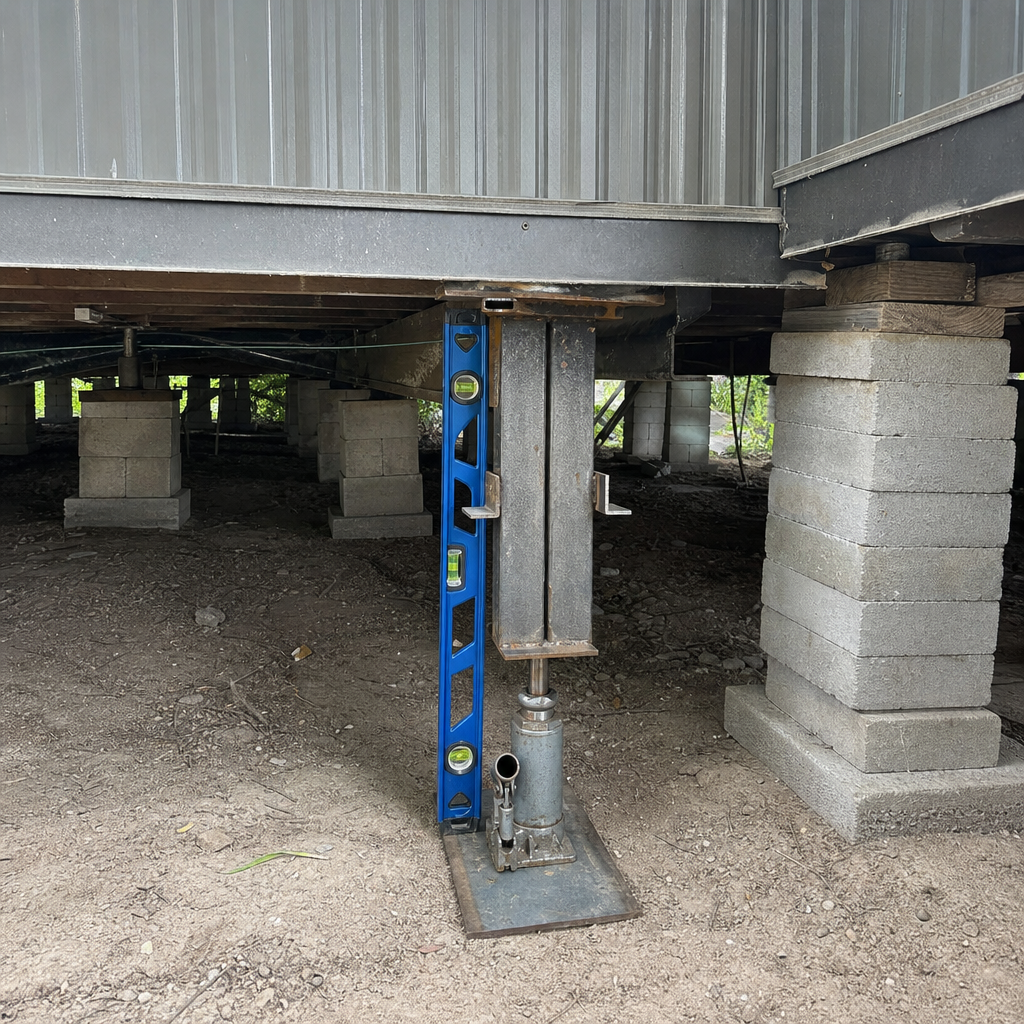
Mobile home leveling brings a settled home’s steel chassis back to flat, even support. In Lakeland that means our crew shoots every pier with a water level, lifts the low sections with 20-ton hydraulic jacks on cribbing, rebuilds and reshims the piers, and verifies the whole frame against the readings. A singlewide runs $450–$800 and takes 3–5 hours; a doublewide runs $750–$1,400 and takes 6–8 hours. The level check that starts the job is free.
This is the most-needed home repair in Polk County that most owners have never watched happen. So here’s the whole process, in the order we do it.
Step 1: Survey: the water level doesn’t lie
Everything starts with measurement. We pull skirting access panels, get under the home, and shoot every single pier with a water level, a fluid-filled tube that reads exact relative height at any point off a single reference. The most stable pier becomes the datum, and each I-beam reading gets marked. What comes out is a map of your frame: this pier is down 5/8”, that one 1-1/4”, the marriage-line row is holding, the northeast corner took the worst of it.
Why a water level and not a laser or a 4-foot bubble level? Lasers work and some crews use them, but water finds its own level with zero calibration and zero drift, under a dark home, at 30 different points. A bubble level on a beam only tells you about the 4 feet it’s touching. The survey is also where everything else gets caught: crushed caps, pads tilting in the sand, rotten shim stacks, slack anchor straps, and tears in the vapor barrier. You get the findings before we quote anything.
Step 2: Lift: small moves, cribbing always
Lifting a home is where amateurs do damage. The frame is two long steel I-beams (plus the marriage line on doublewides), and it will flex, but crank one point far out of plane and the drywall above it cracks, trim pops, and window frames rack. So we work the frame: 20-ton hydraulic bottle jacks set on solid wood cribbing, positioned near each low pier, raising in small increments and moving along the beam so the whole line comes up together.
One safety point that tells you whether a crew knows the trade: nobody works under a home held only by a jack. Hydraulics fail; cribbing doesn’t. The load always rests on solid stacked cribbing while hands are under the beam. If you ever watch a “leveler” crawl under a frame supported by a single bottle jack, send them home.
Step 3: Rebuild the piers
As each section reaches the line, the pier under it gets rebuilt to carry load properly. Concrete blocks re-stacked or replaced, crushed or rotted caps swapped, and hardwood shims driven tight between the pier cap and the I-beam, tight meaning driven with a hammer until the pier takes full load, not slipped in by hand.
HUD installation standards (Part 3285) limit how much shim and lumber stack is allowed on top of a pier. That limit exists because tall stacks are unstable under lateral load. A pier that has settled far enough to need a tall stack doesn’t get more lumber. It gets rebuilt from the pad up, which is pier and pad repair and priced per pier ($150–$400 rebuilt). Two honest pier rebuilds on the quote beat a wobbling wood tower under your bedroom.
Step 4: Verify, then re-secure
When the lifting’s done, we re-shoot the entire frame against the original survey. Every pier gets checked for load. A pier you can rattle by hand is carrying nothing and gets re-shimmed until it can’t move. On doublewides, we confirm the marriage line closed back up: the gap that opens along the centerline ceiling and floor when the two halves settle differently should visibly tighten as the halves come back level.
Last, the straps. A settled home leaves its anchor straps slack, the home dropped, the anchors didn’t. Re-tensioning to spec is part of every relevel, because a June hurricane season with loose straps is a genuinely bad combination in Central Florida. If the survey turned up corroded or missing anchors, common in pre-1994 homes around Combee Settlement, Highland City, and the older US-92 parks, a proper Rule 15C-1 retrofit gets quoted separately. Then the skirting goes back on and the job’s done.
What it costs
| Home | Range | Typical time |
|---|---|---|
| Singlewide | $450–$800 | 3–5 hours |
| Doublewide | $750–$1,400 | 6–8 hours |
| + pier rebuilds where needed | $150–$400 per pier | added to above |
Size, how far out of level, access under the home, and pier condition move the number within the range, the pricing page breaks down each factor. The quote after the free survey is flat.
Why Lakeland homes settle: sand, rain, and Milton
Polk County’s soil is predominantly sand, and sand consolidates under point loads. Each pier presses several thousand pounds into a footprint smaller than a doormat, and every summer the June-through-September rains lubricate the process: water migrates fines, the sand repacks tighter, the pier goes down a little. Homes near lakes and in low spots settle faster; so do homes where a downspout or AC condensate line dumps water beside a pier line.
Then there are the step-changes. Hurricane Milton (October 2024) put more than 12 inches of rain on the Lakeland area in 24 hours. Ground that saturated gives up fast, and homes still turn up today with one side down an inch that were fine before that week. If your home hasn’t had a frame survey since Milton, that alone is reason for the free check.
And the honest part: on this ground, releveling recurs every 3–5 years unless the water problem gets fixed. We will tell you what’s fixable on your lot (usually gutters, downspout extensions, and grading), because a customer whose home stays level longer calls us back for the next job anyway.
Park homes vs. homes on private land
Roughly speaking, Lakeland-area homes come in two situations, and the survey plays out a little differently in each. In a park (the 55+ communities off US-98 North, the family parks along US-92) the home usually has a documented set-up, a predictable pier grid, and a park office that wants to know a crew is on site. Access is tighter, but we are rarely surprised by what’s under the skirting, and when the home sells, the park’s level-and-tie-down requirements are exactly what the pre-sale inspection documents.
On private land (Kathleen, the acreage east of Combee Settlement, lots outside the city grid) the home was often placed decades ago, sometimes owner-set, with no records of what’s under it. These surveys turn up the widest range of findings: non-standard pier spacing, mixed block types, anchoring that predates current Rule 15C-1 counts, and the occasional septic or well line running near a pier row that we need to know about before staging jacks. None of that changes the price of a relevel, it changes how much the measurement matters. Either way, singlewide and doublewide rates are the same published numbers, and the free survey is where the differences get found rather than guessed at.
Settling vs. sinkholes: a question worth taking seriously
Lakeland sits on karst limestone in a sinkhole-prone part of Florida, and homeowners here are right to ask. The honest answer: ordinary pier settling and sinkhole activity look different underneath, and we know the difference. Uniform or drainage-patterned settling across pier lines is soil compaction, routine. A depression forming in the ground surface, circular cracking, or piers dropping fast in one concentrated spot is a pattern nobody should shim over; get geotechnical eyes on it first. A relevel is the fix for settling. It is not the fix for a sinkhole, and any operator who treats them the same is dangerous.
Licensed, per Florida law
Under §320.8249, Florida Statutes, leveling, blocking, and tie-down work on an installed mobile home must be performed by a state-licensed mobile home installer working to Rule 15C-1/15C-2 standards. Checking that licence is your strongest protection on a job you can’t easily inspect yourself.
Ready for readings instead of guesses? Book the free level check: we work all of Lakeland plus Winter Haven, Auburndale, Plant City, and Bartow. Wondering whether your symptoms mean leveling at all? The FAQ sorts the signals from the noise.
Frequently Asked Questions
What does a full relevel include in Lakeland?
A water-level survey of every pier, hydraulic jacking on solid cribbing, pier-by-pier reshimming with new hardwood shims, a verification re-shoot of the whole frame, anchor strap re-tension, and the skirting closed back up. Singlewides run $450–$800, doublewides $750–$1,400, quoted flat after a free survey.
How far out of level is too far to wait?
If doors won't latch or you can see a slope, book the check now, settling compounds, because a low pier shifts load to its neighbors and speeds their settling too. A home that's a quarter-inch out can often wait for a convenient date; a corner down two inches is loading the frame in ways it wasn't built for.
Can you level my home while I'm not there?
Yes, as long as we can get under the skirting and you're reachable by phone. Plenty of our jobs are for snowbird owners in Cypress Lakes or Lakeland Harbor who are up north for the summer: we send the survey readings before and after, and the home is buttoned up when you return.
Will a relevel fix my sticking doors and sloped floors?
In most homes, yes, doors and windows hang off the frame, so bringing the frame back to level typically restores them within days as the structure relaxes. If a door still binds after a proper relevel, the issue is usually the door unit itself or subfloor moisture damage, and we will tell you which.
Why does my home keep needing this every few years?
Polk County sand compacts under concentrated pier loads, and heavy summer rain accelerates it. A relevel every 3–5 years is normal here. Improving drainage (gutters, downspout extensions, grading water away from the piers) is the one thing that genuinely stretches the interval; we will point out what applies to your lot.
Is leveling different for a park home than for a home on private land?
The physical job is identical and so is the pricing. What differs is what we walk into: park homes usually have set-up records, standard pier layouts, and a manager to loop in on access, while private-land homes were often set up decades ago with no paperwork, so the water-level survey does more of the diagnostic work. Permits for anchor work apply the same either way.
More mobilehome services
- Pier & Pad Repair for Mobile Homes in Lakeland
- Tie-Downs & Anchors for Mobile Homes in Lakeland
- Mobile Home Underbelly & Vapor Barrier Repair in Lakeland
- Mobile Home Skirting Repair in Lakeland
- Pre-Sale Leveling Inspection for Lakeland Mobile Homes
- Mobile Home Roof-Over and Roof Coating in Lakeland
- Mobile Home Subfloor and Floor Repair in Lakeland
- Mobile Home Carport & Screen Room Repair in Lakeland
Areas we serve
- Lakeland, FL
- Mobile Home Leveling and Tie-Downs in Lake Wales, Florida
- Mobile Home Leveling and Underbelly Repair in Polk City, Florida
- Mobile Home Leveling in Auburndale, Florida
- Mobile Home Leveling in Bartow, Florida
- Mobile Home Leveling in Plant City, Florida
- Mobile Home Leveling in Winter Haven, Florida
- Mobile Home Tie-Downs and Leveling in Mulberry, Florida