 Lakeland Mobile Home Leveling
 Pier & Pad Repair for Mobile Homes in Lakeland
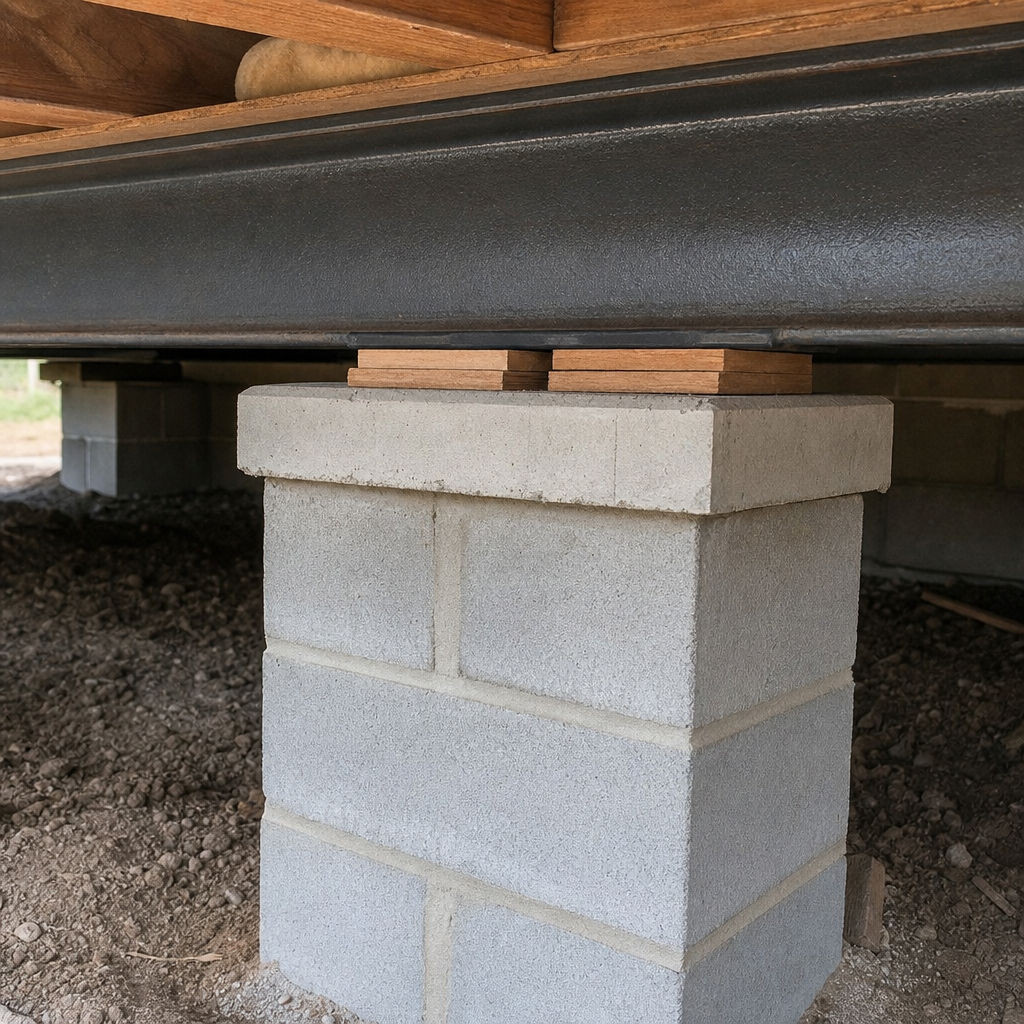
Pier and pad repair fixes the actual support system under your mobile home: the footing pads, concrete block stacks, caps, and shims that carry the frame. In Lakeland, a reset/reshim runs $75–$150 per pier and a full rebuild with new blocks, cap, and pad runs $150–$400 per pier; typical multi-pier jobs land $500–$2,500 all-in. Every job starts with a free under-home survey that tells you exactly which piers need what.
If releveling is the adjustment, pier work is the hardware. The two usually happen together. You can’t bring a frame to level on piers that can’t hold it there.
What’s actually under your home
Most manufactured homes in Polk County sit on the same basic system, whether it’s a 1978 singlewide in Combee Settlement or a 2019 doublewide in a new-phase community off the Polk Parkway:
- Footing pads: concrete pads (or on older installs, sometimes just treated wood) that spread each pier’s load into the soil.
- Block stacks: open- or closed-cell concrete masonry blocks, dry-stacked, single or double depending on height and load.
- Caps: solid concrete or hardwood tops that bridge the block cells so the load transfers cleanly.
- Shims: hardwood wedges driven tight between cap and I-beam to take up the final fraction of an inch.
Each pier carries thousands of pounds into a couple square feet of sandy Central Florida soil. The system works, it’s carried millions of homes for decades, but every component has a failure mode, and Lakeland’s climate finds all of them.
How piers fail in Polk County
Pads sink and tilt. Sand consolidates under sustained point load, and it consolidates fastest when wet. A pad that’s sunk evenly just lowers its pier; a pad that’s tilted lets the whole block stack lean, and a leaning stack loses capacity fast. Homes that took the brunt of Hurricane Milton’s rainfall, over a foot in 24 hours across the Lakeland area, often show one or two pads noticeably worse than the rest, on whichever side the water moved through.
Caps crush and wood rots. Undersized or weathered caps crack under load. On older installs with wood components, Florida moisture and termites do what they always do. A crushed cap drops the beam an inch all at once, which is why some homes go out of level suddenly rather than gradually.
Shim stacks creep past the limit. Every relevel adds shims, and after two or three cycles of settling, some piers end up with a tall wood sandwich on top. HUD Part 3285 limits how much shimming is allowed above a pier, beyond that, the stack is unstable under lateral load and the pier must be rebuilt taller instead. Plenty of “cheap relevels” around here just keep stacking lumber. When the survey finds an over-tall stack, the pier gets rebuilt. That’s the difference between fixed and re-fixed-every-year.
Blocks crack. Less common, but freeze-free Florida still cracks blocks through overload and point contact from tilted caps. Cracked blocks get replaced, never reused.
Reset vs. rebuild: how the call gets made
The free survey maps every pier with a water level and grades what’s under it. The decision rule is simple, and you should be shown the readings:
| Condition | Fix | Cost |
|---|---|---|
| Pier sound, home settled less than the shim limit allows | Reset / reshim | $75–$150 per pier |
| Cap crushed, blocks cracked, or stack past HUD shim limit | Rebuild: new blocks, cap, shims | $150–$400 per pier |
| Pad sunk or tilted | Rebuild including new pad, set on compacted base | $150–$400 per pier (upper end) |
| Pier missing or fully out of contact | New pier built to the home’s spec | quoted in survey |
Nobody gets quoted a full rebuild on piers that only need shims. It’s the same principle as the published pricing generally: the survey is the estimate, and it’s verifiable. We show you the same readings we are working from.
What a rebuild looks like, step by step
The frame near the pier gets lifted a controlled amount on a 20-ton jack over cribbing, just enough to unload the pier, never enough to rack the home. The old stack comes out. If the pad is bad, it comes out too, the base gets compacted and leveled, and a new pad goes down. New blocks are stacked plumb, a solid cap goes on, and hardwood shims are driven tight until the pier takes full load. Then the jack comes down, the water level confirms the beam is on the line, and the crew moves to the next one. On a doublewide, marriage-line piers get matched to both halves so the centerline stays closed.
While we’re under there, we’re also looking at the things pier failure damages: anchor straps that went slack as the home dropped, and the vapor barrier, which settling loves to tear right at pier points. You hear about both from us, with prices, and decide what to do: no surprise add-ons, no scare pitch.
Why this is licensed work in Florida
Blocking and support work on an installed mobile home falls under §320.8249, Florida Statutes. It must be performed by a state-licensed mobile home installer to the standards in Rule 15C-1. That’s not bureaucratic trivia. A pier rebuilt wrong carries your bedroom on an unstable stack, and the failure mode shows up during a windstorm, which is the worst possible time. Whoever quotes the work, ask for their installer licence.
Catch it early: the math favors you
A single pier reset caught at the sticking-door stage costs about as much as a nice dinner out. Left two years, that dead pier overloads its neighbors, the settling spreads down the beam (a sagging I-beam is where that road ends), the skirting buckles, and you’re into a multi-pier rebuild plus a full relevel. The free survey exists so the affordable version stays available to you. We do them across Lakeland, Winter Haven, Auburndale, Plant City, Bartow, Mulberry, and Lake Wales, and are usually booked within a couple of days of a call, sooner if a pier is fully out of contact.
Frequently Asked Questions
How much does pier repair cost in Lakeland?
Resetting and reshimming an existing pier runs $75–$150 per pier when done during a relevel. A full rebuild (new pad, new blocks, new cap) runs $150–$400 per pier. Most multi-pier jobs land between $500 and $2,500 all-in, quoted flat after a free under-home survey.
How many piers does a mobile home have?
A typical singlewide has 10–20 piers along its two I-beams; a doublewide has 20–40 plus a marriage-line row down the center. Spacing is set by the home's installation manual and HUD standards, usually every 5–8 feet along the frame. It's normal for only a handful to need work at any one time.
What's wrong with just adding more shims to a low pier?
HUD standards cap how tall the shim-and-lumber stack on top of a pier can be, because tall stacks walk and tip under lateral load, exactly what you don't want in a hurricane. A pier that's sunk past the shim limit needs to be rebuilt taller from the pad up, not stuffed with more wood.
Why did my piers sink in the first place?
Polk County sand compacts under the concentrated load each pier carries, and water accelerates it: summer rains, roof runoff without gutters, AC condensate dripping at the frame line. Pads spread the load, but on soft or wet sand they tilt and sink too. Fixing the water source is the only thing that slows recurrence.
Can a single failed pier really matter that much?
Yes. When one pier stops carrying load, its share shifts to the neighbors, which overloads them and speeds their settling, a slow chain reaction along the beam. That's why a $150 reshim caught early often prevents a $1,500 multi-pier rebuild two years later.
More mobilehome services
- Mobile Home Leveling in Lakeland, Florida
- Tie-Downs & Anchors for Mobile Homes in Lakeland
- Mobile Home Underbelly & Vapor Barrier Repair in Lakeland
- Mobile Home Skirting Repair in Lakeland
- Pre-Sale Leveling Inspection for Lakeland Mobile Homes
- Mobile Home Roof-Over and Roof Coating in Lakeland
- Mobile Home Subfloor and Floor Repair in Lakeland
- Mobile Home Carport & Screen Room Repair in Lakeland
Areas we serve
- Lakeland, FL
- Mobile Home Leveling and Tie-Downs in Lake Wales, Florida
- Mobile Home Leveling and Underbelly Repair in Polk City, Florida
- Mobile Home Leveling in Auburndale, Florida
- Mobile Home Leveling in Bartow, Florida
- Mobile Home Leveling in Plant City, Florida
- Mobile Home Leveling in Winter Haven, Florida
- Mobile Home Tie-Downs and Leveling in Mulberry, Florida